Tomasz Hanusiak, creator of Blefuj
·
The settings and mechanics described here exist in the Blefuj game. House rules that the app does not enforce are clearly labelled.
Impostor is a fast bluffing-and-deduction game for 3–10 people on one phone. Most players know a secret word; one or more impostors don't and must pretend they do. Below you'll find the complete rules, an example round and tips.
Setup
- Set the number of players (3–10) and how many impostors.
- Pick a word category, e.g. Food, Movies or Travel.
- Pick a hint mode: no hints, a hint for the impostor, or hints for everyone (explained below).
- Enter names or play anonymously, names stay on your phone only.
Revealing roles
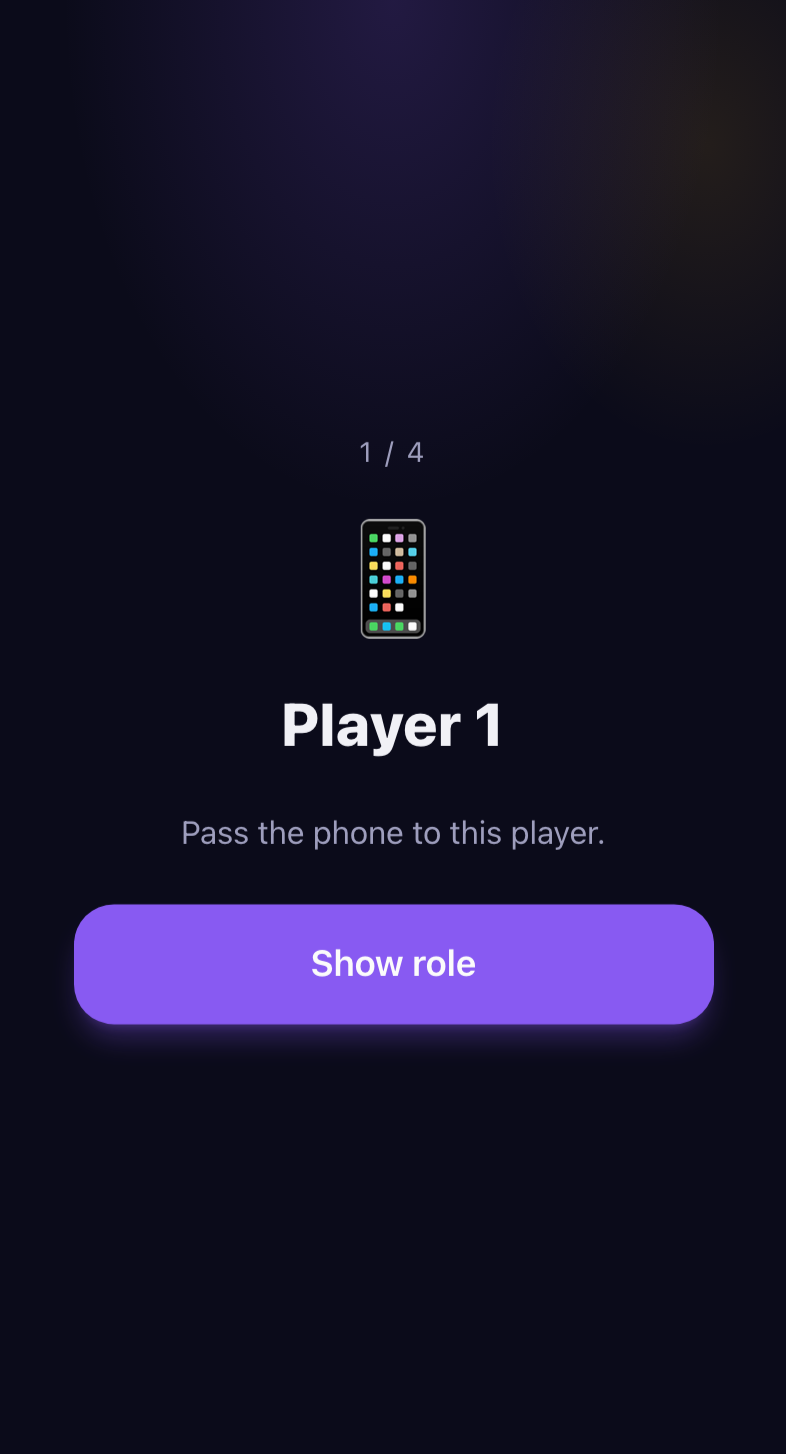
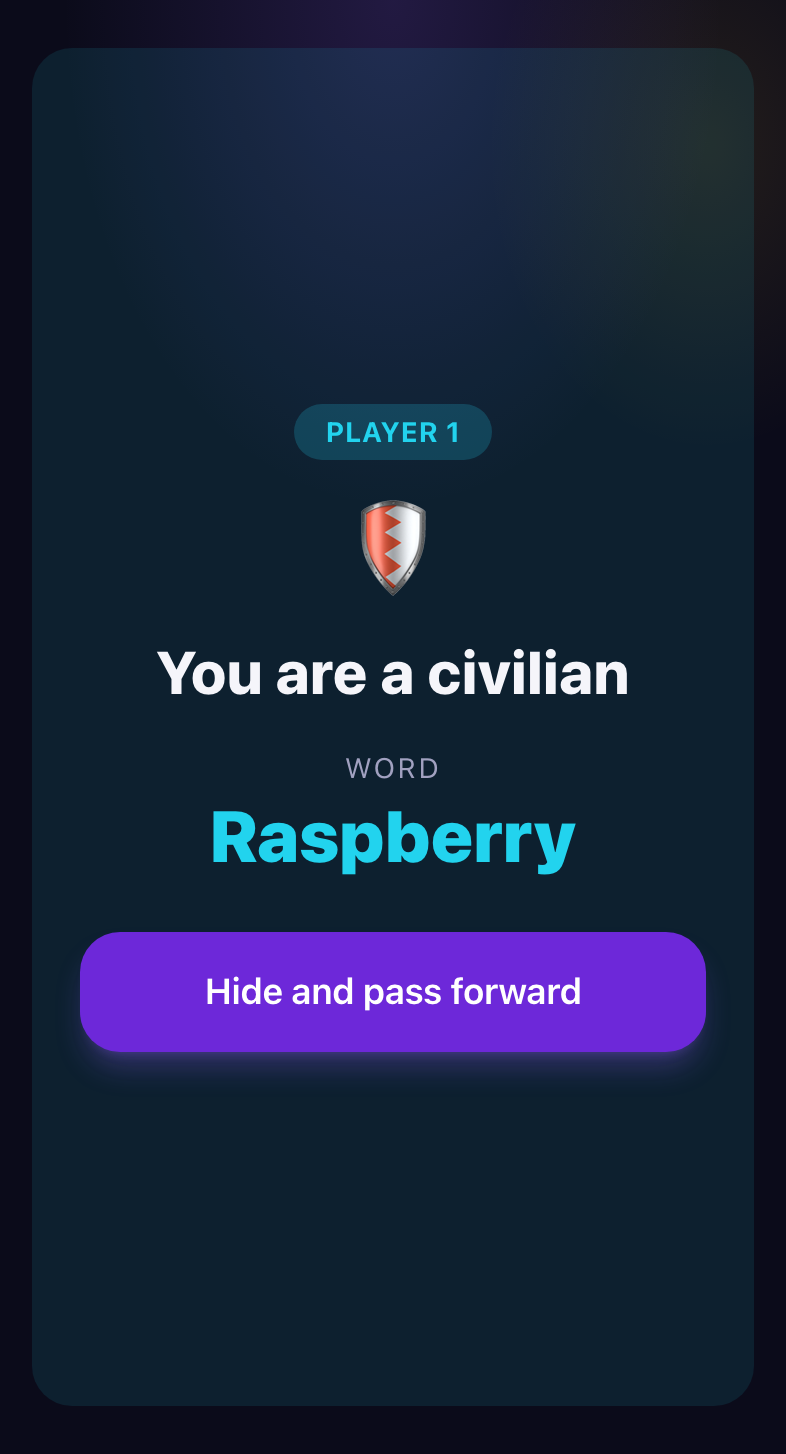
The phone travels around the group. Each player reveals their role on a private screen, one at a time, so nobody else can see it. Civilians see the secret word; the impostor only sees that they're the impostor (or a gentle hint if you enabled that mode).
Important: don't show your role screen to others, and only pass the phone after closing your card. The next role never reveals itself automatically.
The round and clues
Going in turns, each player says one word or a short association linked to the secret. Civilians want to prove they know the word without giving it away too directly. The impostor bluffs, listening to others and blending in so as not to break the rhythm.
- Too obvious a clue hands the word to the impostor.
- Too vague a clue makes you look suspicious yourself.
Voting and the result
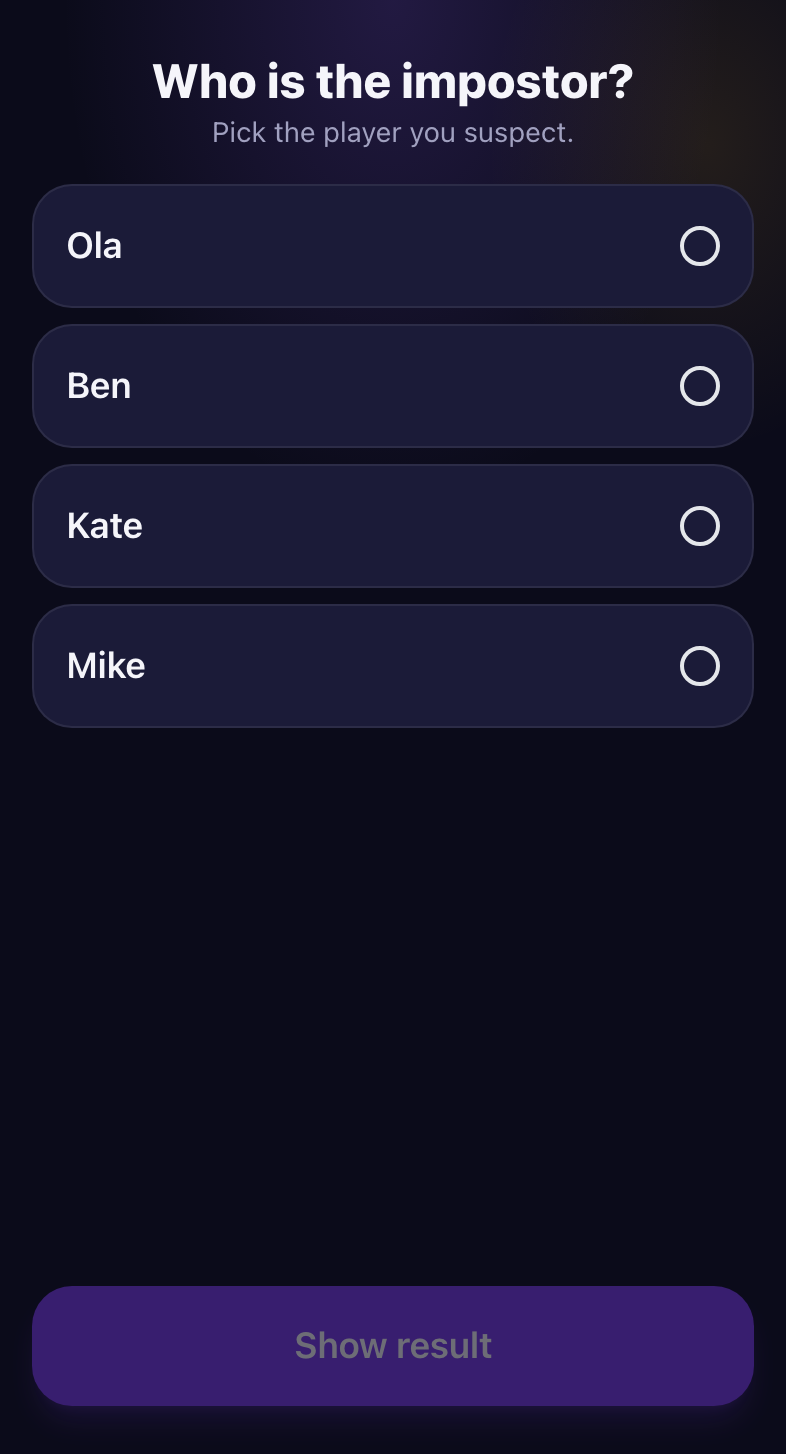
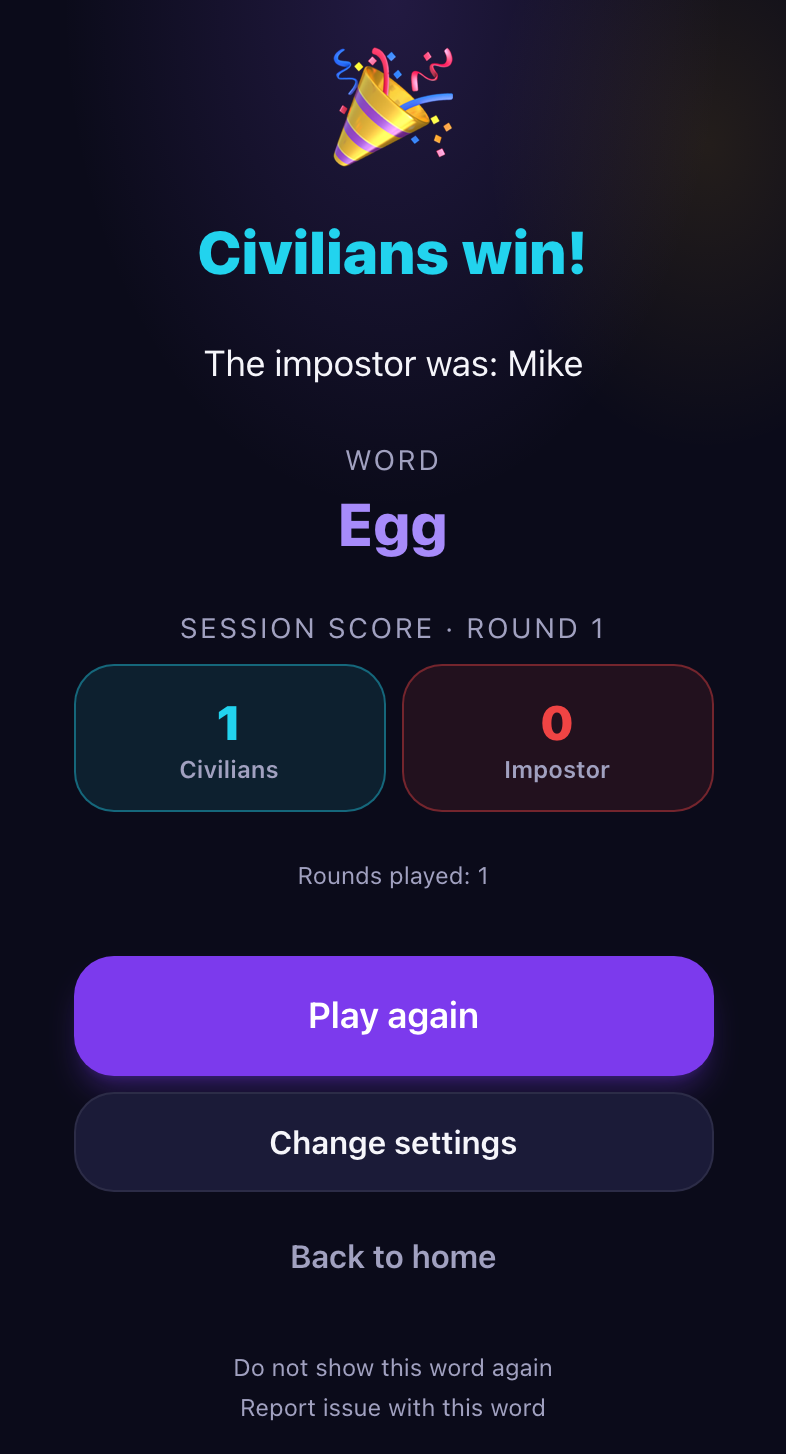
After the clue round the group discusses and points at one person in the app. If that's the impostor, the civilians win; if not, the impostor wins. The result screen reveals the word and the impostor's name and keeps a tally of wins for the session as long as you keep hitting “Play again”. If you like the “last chance” house rule, where a caught impostor saves themselves by guessing the word, settle it aloud before anyone taps “Show result”.
An example round
Category: Food. The civilians' word: “pizza”. The impostor doesn't know it. Clues in turn: “Italian”, “round”, “with cheese”, while the impostor plays it safe with “warm”. It sounds neutral but too generic, and that's exactly what draws the group's attention at the vote.
A second example round
Category: Travel. The civilians' word: “airport”. Clues in turn: “suitcase”, “queue”, “passport”. The impostor, not knowing the word, offers “far away”, it fits travel but not the specific place. In the discussion someone asks for a detail and the vague answer gives them away. Had they caught “passport” and “queue” earlier, though, they could risk a sharp “check-in” and survive.
The three hint modes, by example
Every word in the database carries two hints: a vague one for the impostor and a clearer one for the civilians. The hint mode decides who sees what on their role screen. Take the word “Pizza” from the Food category:
| Mode | Civilians see | The impostor sees |
|---|---|---|
| No hints | Pizza | only that they are the impostor |
| Hint for the impostor | Pizza | “Something related to food.” |
| Hints for everyone | Pizza plus “A round dough dish with sauce and cheese, often with toppings.” | “Something related to food.” |
- No hints: hardest for the impostor; pick it when the impostor wins too often or your crew is experienced.
- Hint for the impostor: the balanced choice to begin with, the impostor at least knows which world they are in.
- Hints for everyone: for new players and harder categories, civilians understand the word with more confidence (say, a lesser-known film title), so their clues get better.
The Chaos variant: an impostor with a similar word
In the Classic variant the impostor doesn't know the word and has to bluff. In the Chaos variant they get a word of their own, similar but different, drawn from a hand-curated list of “neighbours” for every word. When the civilians have “Pizza”, the impostor might get “Hamburger”, “Taco” or “Lasagna”. Their role screen warns them that their word may differ from everyone else's, but not by how much.
The effect: the impostor sounds confident and specific, yet every so often a clue is slightly off. Civilians have to spot not “who's bluffing” but “who's talking about something similar, yet not this”. The result screen shows both words, so you immediately see which clues gave the difference away. Chaos works best with concrete categories (Food, Animals, Transport), where similar words really are close to each other.
Common player mistakes
- A civilian gives an obvious clue and hands the word straight to the impostor.
- A civilian is so cryptic they look as suspicious as the impostor.
- The impostor talks too much, the more detail they invent, the easier to catch.
- The group votes in silence with no debate, yet the debate is the best part.
- You reuse the same category every round and the game gets predictable.
Variants: what's in the app and what's a house rule
You set these in the app:
- Two impostors (from 6 players) or three (from 9): more chaos and quiet alliances.
- Hint mode: none, for the impostor, for everyone (see above).
- The Chaos variant: the impostor plays a similar but different word.
- Difficulty (Mix, Easy, Medium, Hard) and Family Mode (only simple, safe words).
House rules the app doesn't enforce, but that we like to add ourselves:
- Timed round: ~10 seconds per clue, timed by someone with a watch; pressure exposes bluffing.
- Last chance: a caught impostor still wins if they guess the word aloud before you open the result screen.
- Silent round: write clues on paper and reveal them all at once.
Settings by player count
How many impostors, which difficulty and which category to pick should all depend on your group size, a game of 3 plays very differently from a game of 10. We've collected recommended starting setups for every group size in a separate guide.
Safe categories to start with
For the first rounds pick universal categories everyone knows, no specialist knowledge and no sensitive topics:
- Food, Animals, Travel, easy and universal.
- Home, Everyday Objects, Nature, good for mixed groups.
- Movies & Series, Sport, Music, when the group shares interests.