Tomasz Hanusiak, creator of Blefuj
·
The settings and mechanics described here exist in the Blefuj game. House rules that the app does not enforce are clearly labelled.
The category shapes a round more than anything else, the pace, the difficulty, and how easily the impostor can hide. Below is a practical profile of the key categories: who they're for, why they work and when they can surprise you. We don't reveal specific words, you'll discover those only in the game.
How categories work
Before dealing roles you pick one category. The game draws a secret word from it for the civilians, while the impostor doesn't know it. A well-chosen category makes the clues interesting but not too easy, that's the heart of a good round. The rule of thumb: the more concrete and “tangible” a category, the easier the game is for civilians; the more abstract it is, the easier the impostor blends in.
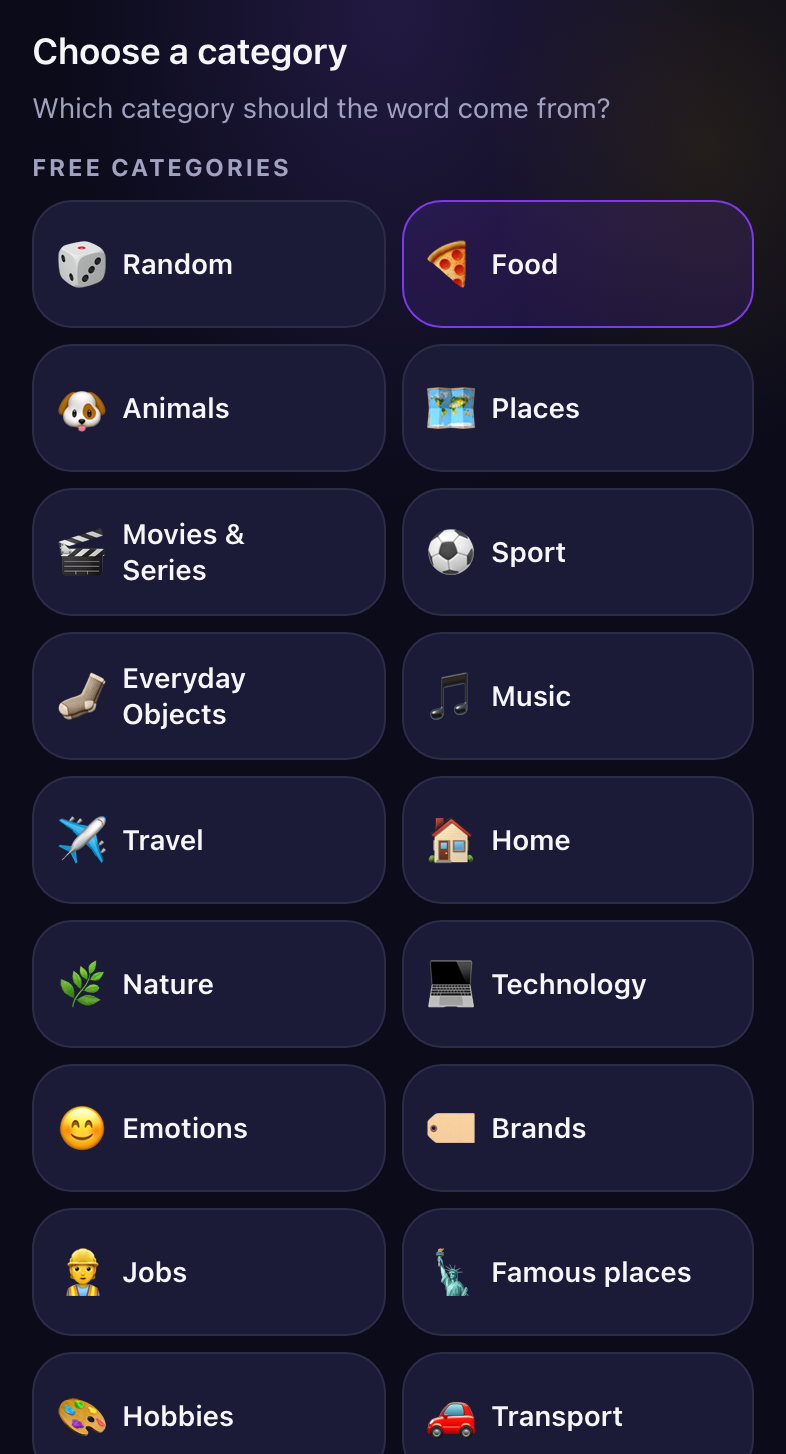
🍕 Food, easy
Best for: beginners and groups of 3–6. Everyone has hundreds of food associations, taste, smell, occasions, how it's served, so civilians don't collide and rounds move fast. It's the safest pick for the first game of the night.
- Clue style: sensory and situational (“crispy”, “for breakfast”, “off the grill”).
- When it gets hard: when a group overplays it and clues become automatic.
- For beginners: yes, absolutely.
🐶 Animals, easy
Best for: families and mixed groups, teenagers included. Animals have vivid features (sound, movement, habitat), so it's easy to find a clue that proves knowledge without naming the word. One caveat: the impostor has an easier time guessing here because the space of animals is fairly countable, consider playing with hints off.
- Clue style: traits and behaviours (“nocturnal”, “in a herd”, “afraid of water”).
- When it gets hard: with exotic species some of the group barely knows.
- For beginners: yes.
✈️ Travel and 🗺️ Places, easy/medium
Best for: groups that like telling stories. Place words trigger memories, so clues are natural and personal, the best fuel for the pre-vote debate. The difficulty rises when the word is a type of place (not a proper name), because clues then tend to fit several places at once.
- Clue style: situational (“a queue”, “a ticket”, “the smell of chlorine”).
- When they get hard: when part of the group has never actually been to that kind of place.
- For beginners: yes, with a slight edge to Travel.
🧦 Everyday Objects and 🏠 Home, easy
Best for: any group that wants zero-friction rounds. Everyday objects are so familiar that the challenge flips: the difficulty isn't finding a clue, it's finding one nobody else will say. Great for learning the core skill of the game, differentiating your clues.
- Clue style: details and situations (“always goes missing”, “in the drawer”, “borrowed”).
- When they get hard: when the word is so ordinary everyone says the same thing.
- For beginners: yes.
🎬 Movies & Series, 🎵 Music, medium
Best for: groups with shared taste, friend groups, flatmates, couples. Clues here are colourful (scenes, genres, emotions), but the game starts testing whether everyone knows the same titles and artists. In a multi-generation group it can unfairly burden some players.
- Clue style: mood and context (“the intro”, “at a concert”, “the 90s”).
- When they get hard: across generations or with niche tastes.
- For beginners: yes, if the group shares interests.
⚽ Sport and 👷 Jobs, medium
Best for: groups of 5+ past their warm-up rounds. Both topics have many clue tracks (equipment, venue, outfit, stereotypes) but need a little general orientation. Jobs are sneakily good: prop-based clues (“a ladder”, “a rubber stamp”) make excellent rounds.
- Clue style: props and venues (“a whistle”, “an arena”, “a desk”).
- When they get hard: with disciplines or professions known by name only.
- For beginners: moderately, better after 2–3 warm-up rounds.
💻 Technology, medium
Best for: groups where everyone uses similar devices and apps, in practice, most adults and teenagers. It works because the words come from daily life (devices, apps, activities), but varying tech literacy can reshape a round: what's obvious to one player is abstract to another. In a mixed group, treat it as a medium category, not an easy one.
- Clue style: activities and frustrations (“an update”, “no signal”, “forgotten password”).
- When it gets hard: when part of the group knows a thing by name but not by use.
- For beginners: moderately.
😊 Emotions, hard
Best for: a seasoned group that wants a real challenge. Abstract concepts have no props or places, clues turn subjective, and even civilians can't be sure someone else's clue fits the word. It's impostor heaven: a vague answer sounds as credible as an honest one here. Play Emotions when you want long debates and hard votes.
- Clue style: situations and symptoms (“a racing heart”, “before an exam”, “hot cheeks”).
- When it gets hard: almost always, that's the point.
- For beginners: not for your first game.
🏷️ Brands, easy
Best for: groups that want a fast, loud round. It's the easiest category in the game, almost 60% of its words are rated easy, because everyone knows brands from ads, shops and phones. Clues go through the product, logo, colour or slogan, without naming it. Note: it's the only free category switched off in Family Mode, so with kids at the table you won't see it.
- Clue style: product-led and visual (“red”, “in every shopping centre”, “has an apple on it”).
- When it gets hard: with a big age gap, when some know a brand from childhood and others not at all.
- For beginners: yes, though seasoned groups outgrow it quickly.
🗽 Famous places, medium
Best for: crews that like travelling or exploring the world online. Landmarks, cities and famous sites produce geographic, historical and “holiday photo” clues. The impostor has it easier here than in Travel, because generalities like “crowds of tourists” fit almost anywhere, so civilians should aim for detail.
- Clue style: geographic and visual (“a tower”, “on an island”, “every tourist's selfie”).
- When it gets hard: when part of the group doesn't recognise the less obvious places, switch on hints for everyone.
- For beginners: so-so, better after a few rounds in the concrete categories.
🎨 Hobbies, medium
Best for: big groups (8–10 people), because it's one of the roomiest categories: every hobby has gear, a place, a time of day and a typical person, so clues don't run dry even at the tenth player. Social bonus: after a round you often find out what people actually do after work.
- Clue style: objects and actions (“with gloves on”, “Sunday morning”, “expensive gear”).
- When it gets hard: with a niche hobby nobody at the table practises.
- For beginners: yes, on Mix or Easy.
🚗 Transport, medium/hard
Best for: seasoned groups and the Chaos variant. It has the largest share of hard words among the free categories (over a quarter), because means of transport resemble each other: many of them drive, carry people and have wheels. That's exactly why an impostor with a similar word in Chaos is almost undetectable here, and civilians have to hunt for genuinely distinguishing traits.
- Clue style: function and place (“on rails”, “with a ticket”, “only in summer”).
- When it gets hard: almost always on Hard; on Easy it's a calm family category.
- For beginners: only on Easy.
🩺 Health, medium
Best for: mixed groups and family play. It's about everyday health and good habits: sleep, exercise, water, a dentist visit, not illnesses or topics that could hurt someone. Clues are situational (“in the morning”, “on an empty stomach”, “once a year”) and rarely collide, because everyone has different routines.
- Clue style: habits and times of day.
- When it gets hard: when a group plays very cautiously, habit words are easy to describe too vaguely.
- For beginners: yes.
📱 Internet (light), easy/medium
Best for: younger groups and crews that live on their phones. It's the largest free category in the game: apps, online phenomena and internet habits, in a “light” version with nothing you wouldn't show your parents. Clues are very contemporary and quick, which is why part of a mixed-generation table may fall behind.
- Clue style: gestures and situations (“I scroll”, “a notification”, “at 2 a.m.”).
- When it gets hard: with a big age gap, hints for everyone save the round.
- For beginners: yes, if the group is of a similar age.
😎 Slang (light), easy
Best for: teens and young adults, as a change of pace. Light, widely known words and phrases, no profanity. It's the smallest free category, with almost only easy and medium words, so treat it as seasoning: one or two rounds, then switch. With parents at the table it gets funny precisely because they don't know half the words.
- Clue style: chat situations and emotions (“when someone doesn't reply”, “on a story”).
- When it gets hard: with mixed generations, for some players the word is simply foreign.
- For beginners: yes, in a young group.
Premium categories, for veterans and parties
The Premium sets are more specialised: from hard words and harder movies, through absurd and party moods, to themes like history or internet culture. Think of them as the “second album” for when the free categories start feeling predictable. Premium is in preparation: for now you only see these categories' names, and every free category is playable. Some deliberately raise the bar (knowledge or abstraction), others shift the round's mood to something looser. Free play stays exactly as it is.
How to choose, the cheat sheet
- First game of the night: Food, Animals or Everyday Objects.
- Mixed generations at the table: Home, Nature, Travel.
- A crew with shared taste: Movies & Series, Music, Hobbies.
- A seasoned group after a challenge: Emotions or Transport on Hard, ideally in the Chaos variant.
- A big group (8–10 people): Hobbies, Nature, Jobs, where clues don't run dry by the last player.
- A young crew: Internet (light) and Slang (light), but not with mixed generations.
- Rotate the category every 2–3 rounds, predictability kills the tension.
Free categories
The free game has 20 categories and 1604 words; another 11 categories are planned for Premium. The number next to each category is how many words it can draw.
- Food83 words
- Animals83 words
- Places83 words
- Movies & Series83 words
- Sport82 words
- Everyday Objects81 words
- Music81 words
- Travel77 words
- Home82 words
- Nature82 words
- Technology81 words
- Emotions81 words
- Brands76 words
- Jobs83 words
- Famous places83 words
- Hobbies80 words
- Transport79 words
- Health79 words
- Internet (light)90 words
- Slang (light)55 words
Categories planned for Premium
- PartyPremium · soon
- Slang (premium)Premium · soon
- Hard wordsPremium · soon
- GamingPremium · soon
- CelebritiesPremium · soon
- DatingPremium · soon
- HistoryPremium · soon
- Hard moviesPremium · soon
- AbsurdPremium · soon
- Polish culturePremium · soon
- Internet culturePremium · soon